
Dynamic Pricing Tools for Airbnb: Are They Worth It?

Karan M
March 6, 2026
in
The world of short-term rentals
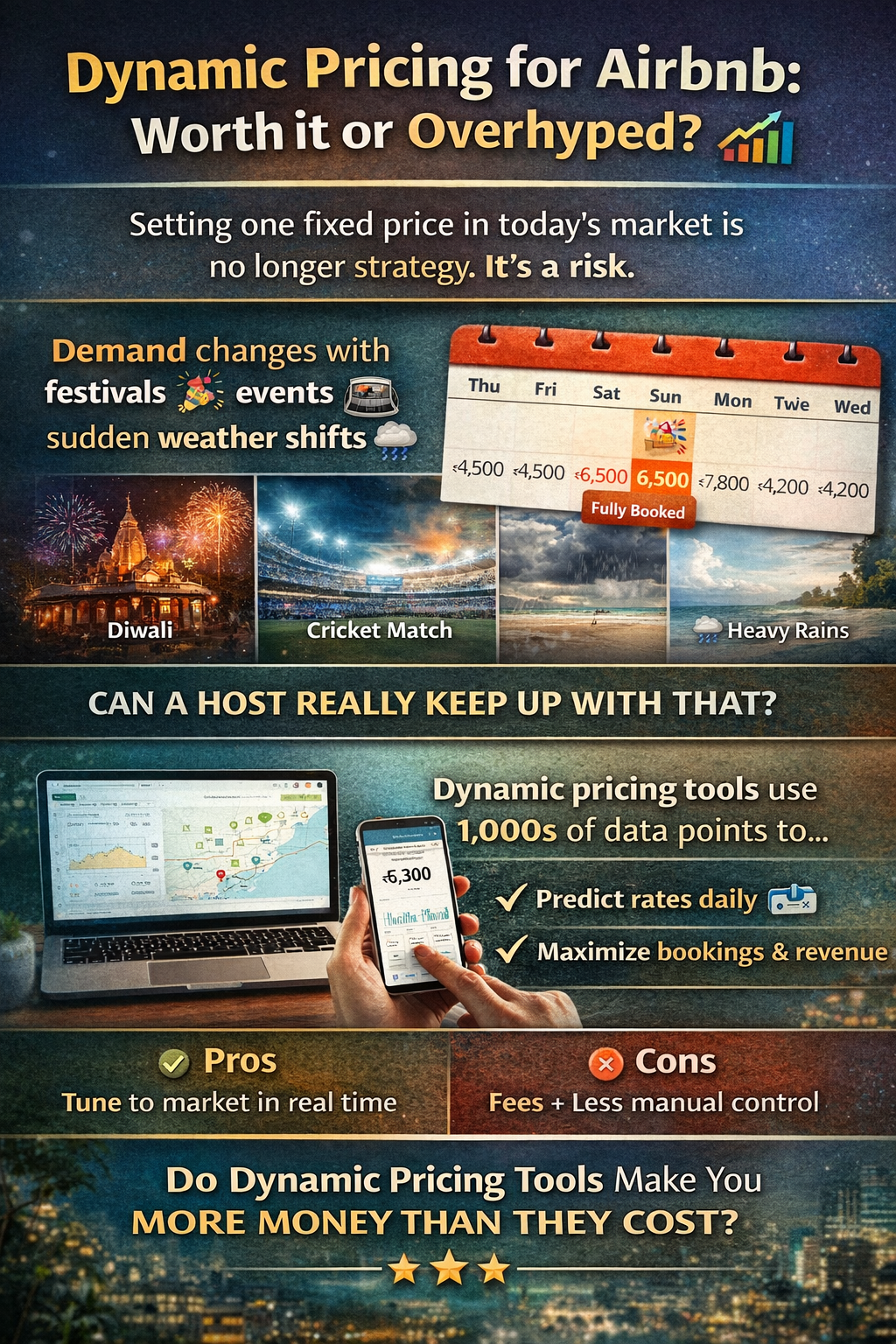
Many hosts in India and across the globe still rely on their intuition or perhaps a glance at their neighbours’ listings to decide what to charge, but this manual approach is increasingly risky and often leads to significant financial loss. When you think about the sheer volume of variables that influence travel demand, such as local festivals like Diwali or major sporting events or even sudden shifts in weather, it becomes clear that a human brain cannot process all this information in real time. This is why the rise of sophisticated Airbnb dynamic pricing tools has become a central topic of conversation for anyone serious about professional hosting. These platforms promise to take the guesswork out of the equation by using advanced algorithms that scan thousands of data points every single night to suggest the perfect price for your property. But as with any investment in your business, you have to ask yourself if the monthly cost and the learning curve are truly worth the return on investment or if you are better off keeping control of the numbers yourself.
The Shift From Manual Guesswork to Software Automation
The traditional way of pricing a vacation rental was a static model where a host would set a weekday rate and a weekend rate and maybe a higher price for the peak season months. This worked well enough a decade ago when there were fewer listings and travellers had fewer choices but the landscape in 2026 is vastly different and much more competitive. Today a guest might be looking at twenty similar apartments in South Mumbai or North Goa and they are looking for the best value at that exact moment. If your price stays at ten thousand rupees because you forgot to adjust it for a sudden long weekend, then you are essentially giving away profit that could have been yours. On the other hand, if you keep your price high during a slow Tuesday in the middle of the monsoon, you will likely end up with an empty house and zero revenue for that night. This is where Airbnb pricing software steps in to act as a twenty-four-hour revenue manager that never sleeps and never misses a market trend. These tools are designed to bridge the gap between supply and demand by ensuring your listing is always positioned to attract the most bookings at the highest possible price.
A Comprehensive PriceLabs Review and Deep Dive
When you start looking into the various options available in the market one name consistently rises to the top of the list, and that is PriceLabs. For many professional property managers and individual hosts, a detailed pricelabs review is the first step toward understanding the true potential of automation. What makes this specific tool stand out is its incredible level of customisation, which allows you to set very specific rules for how your pricing should behave in different scenarios. You can tell the software to never drop below a certain minimum price to protect your margins or you can set aggressive discounts for orphan days, which are those pesky single nights between two longer bookings that usually go unbooked. PriceLabs also offers a flat fee model, which means you pay a set amount per listing every month, regardless of how much money you make. This is often preferred by high-volume hosts because it makes their overhead predictable and it does not penalise them for being successful. However, it is important to note that the interface can be quite intimidating for a beginner because it is packed with charts and toggles and complex settings that require a few days of study to master.
Comparing the Giants Beyond and Wheelhouse
While PriceLabs is a powerhouse, it is certainly not the only player in the field and you must consider alternatives like Beyond and Wheelhouse to see which fits your style of management. Beyond is famous for its user-friendly interface and its Health Score feature, which gives you a simple percentage to tell you how well your listing is performing relative to the market. Unlike the flat fee model of some competitors, Beyond typically charges a percentage of your total bookings, which can be a double-edged sword. It is great for new hosts who are just starting out because they only pay when they get a booking, but it can become quite expensive as your revenue grows into the millions of rupees. Wheelhouse is often seen as the middle ground between the two because it offers a sleek and modern design paired with very powerful data science that focuses on long-term revenue goals. Choosing between these Airbnb dynamic pricing tools often comes down to whether you prefer a hands-off approach with a polished UI or a hands-on approach with deep technical control.
The True Cost of These Tools and the Return on Investment
The most common question hosts ask is whether they can justify spending twenty dollars or more every month on a piece of software when they are already paying platform fees and cleaning costs and maintenance. To answer this, you have to look at the numbers through a lens of incremental gains rather than just the base cost. If a piece of Airbnb pricing software helps you book just one extra night per month or allows you to raise your rates by five percent during a busy weekend, it has already paid for itself multiple times over. In fact, many professional studies show that properties using dynamic pricing see a revenue increase of anywhere from ten to forty percent compared to those using manual rates. You are not just paying for a tool, but you are paying for the time you save and the peace of mind that comes from knowing your business is optimised. When you consider the hours spent every week manually checking competitor prices and updating calendars, it becomes clear that the software is often one of the highest value investments you can make in your hosting career.
Navigating the Learning Curve and Setting Your Boundaries
One of the biggest mistakes a host can make is treating these tools as a set it and forget it solution without any human oversight. Even the most advanced algorithm can sometimes misread a hyperlocal trend or fail to understand the unique value of your specific property. This is why you must invest the time to set your “Base Price” correctly, which is the anchor that all other adjustments are built upon. If your base price is too low, the software will keep you booked, but at a rate that might not be sustainable for your business. If it is too high, the algorithm will struggle to find guests even with heavy discounts. You must also spend time setting your minimum stay requirements because pricing and stay length are two sides of the same coin. For example, you might want a three-night minimum during the peak wedding season in Jaipur, but you might be willing to accept a one-night stay on a random Wednesday to fill a gap. The magic happens when the software handles the heavy lifting of data analysis while you provide the local context and the strategic direction.
The Role of Market Dashboards and Competitive Intelligence
Beyond just changing your nightly rates, these platforms offer a wealth of competitive intelligence that can help you make better decisions about your entire business. You can see exactly how many listings are in your neighbourhood, what their average occupancy is and which amenities are most popular among guests. If you see that every successful listing in your area has a high-speed internet connection and a dedicated workspace, but yours does not, you have a clear roadmap for where to invest your next round of profits. This data-driven approach turns you from a landlord into a sophisticated entrepreneur who understands the pulse of the market. You can track lead times to see if people are booking your home six months in advance or six days in advance, which tells you exactly how much room you have to push your prices higher. This level of insight is almost impossible to gain manually, and it is a core reason why professional managers rely so heavily on these digital companions.
Integrating Pricing Software Into Your Daily Workflow
To get the most out of your chosen tool, you should integrate it into a weekly routine where you spend at least thirty minutes reviewing your performance and adjusting your goals. You should look at your upcoming calendar and see if there are any red flags, like an empty month or a weekend that booked out instantly at a low price. Most Airbnb dynamic pricing tools offer a sync function that automatically pushes your new rates to the Airbnb platform every few hours, so you don’t have to worry about manual updates. If you are using a property management system to handle multiple platforms like Booking.com and Vrbo alongside Airbnb, these pricing tools usually integrate seamlessly so that your prices stay consistent across the entire internet. This prevents a situation where a guest finds a lower price on one site and feels cheated or where you accidentally double-book because of a calendar lag.
Why Some Hosts Still Hesitate to Automate
Despite the clear benefits, there are still many hosts who are sceptical about giving up control to an algorithm. Some fear that the software will lower their prices too much and attract “low-quality” guests who might not respect the house rules. Others simply find the technology too overwhelming and prefer the comfort of their own spreadsheets. While these concerns are valid, they can usually be addressed by setting strict “Minimum Price” guardrails that the software can never cross. In the long run, the risk of human error and the opportunity cost of missed bookings far outweigh the risks of automation. The global travel market is moving toward a model where pricing is as fluid as the stock market and those who refuse to adapt will find it harder and harder to compete with professionalised operations.
Final Thoughts on Scaling Your Business with Data
As we look toward the future of hosting in India, it is clear that the successful hosts will be the ones who embrace technology without losing the human touch of hospitality. Using a tool like PriceLabs or Beyond allows you to reclaim your time so that you can focus on the things that really matter, like guest communication and property maintenance and creating a memorable experience for every person who walks through your door. Your pricing strategy should be a living and breathing part of your business that evolves as you learn more about your guests and your market. Whether you are managing a single room or a portfolio of villas, the goal is the same, which is to provide great value while maximising the return on your hard work.
Host Voyage understands that the technical side of property management can be daunting for many owners, which is why we offer comprehensive support to ensure your listing is always performing at its peak. We believe that every host deserves to have the best tools at their disposal, and we are here to help you navigate the complex world of dynamic pricing with confidence. Our team has spent years testing every piece of Airbnb pricing software on the market to find the perfect balance for the unique challenges of the Indian landscape. We know that a villa in the hills of Coorg requires a different strategy than a studio apartment in the tech hubs of Bangalore, and we are dedicated to helping you find that winning formula.
Investing in your pricing strategy is one of the smartest moves you can make as an entrepreneur because it directly impacts your bottom line every single day. The data is clear and the technology is ready and the only thing left is for you to leap into a more professional and profitable way of hosting. You have built a beautiful home and now it is time to make sure the world sees its true value through a price that is fair and competitive and optimized for success.
Do you want us to manage your property?
|